


Jackery Explorer 300 v2 Portable Power Station
Jackery Explorer 300 v2 Portable Power Station
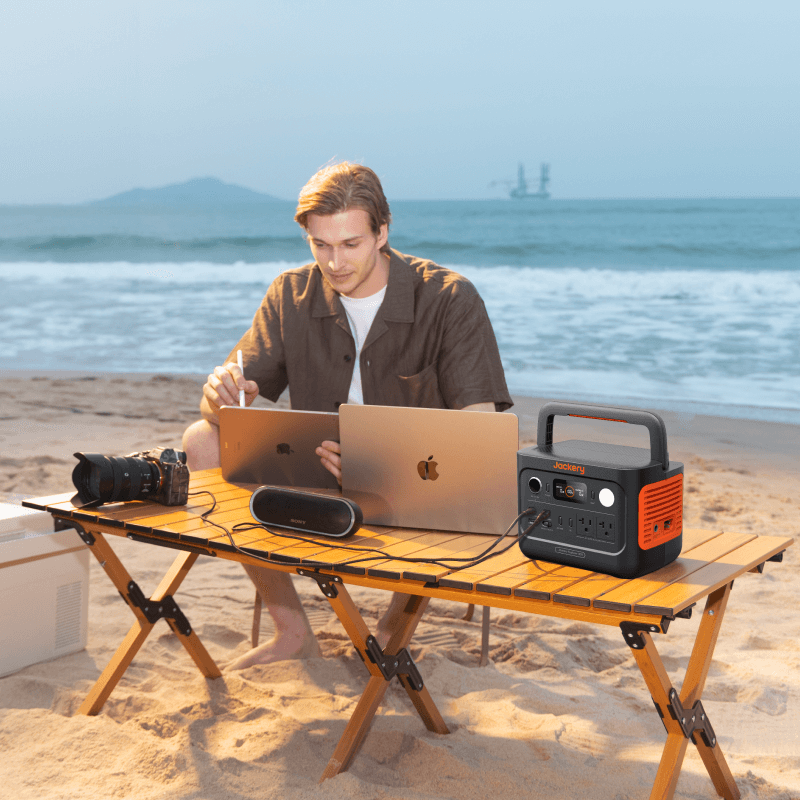
The Jackery Explorer 300 v2 is a 288Wh LiFePO4 power station that weighs 8.1 lbs and fits in one hand. It runs 300W continuous (600W surge) through two AC outlets, a 100W USB-C port, a second 15W USB-C, a USB-A, and a 12V car port. That is enough to keep phones, lights, a fan, a laptop, and camera gear topped off for a weekend without a wall plug.
The LiFePO4 cells are rated for 4,000+ charge cycles, so daily use puts the pack near a decade before it fades to 80%. Recharge is fast: about an hour to 80% on AC wall power, roughly 4 hours from a 12V car port, and about 9.5 hours from a SolarSaga 40W panel under full sun (100W max solar input). Plug it into the wall and it doubles as a UPS, switching to battery in 20ms when the grid drops, so a router or modem never reboots.
Know the ceiling before you buy: 300W continuous means low-draw gear only. Phones, lights, fans, laptops, CPAPs, and small electronics are the sweet spot. Coffee makers, hair dryers, and most power tools pull more than 300W and won't run. The shell is UL94V-0 flame-retardant and the BMS holds stable output down to -10°C.
Couldn't load pickup availability


Overview
The Explorer 300 v2 is Jackery's compact entry station: 288Wh of LiFePO4 capacity, 300W continuous output, and an 8.1 lb body with a foldable handle. Built for low-draw devices on short trips and short outages.
Key features
- 288Wh LiFePO4 battery rated for 4,000+ charge cycles
- 300W continuous AC output (600W surge) across two 120V outlets
- 100W USB-C PD port plus a 15W USB-C, a USB-A, and a 12V/10A car port
- Recharges to 80% in about an hour on AC wall power
- UPS pass-through with ≤20ms switchover to keep electronics from rebooting
- 8.1 lb (3.7 kg) with a foldable carry handle; 9.1 x 6.0 x 6.6 in
Use cases
Best for weekend tent or car camping (phones, lights, fan, small electronics), digital nomads recharging cameras and drones, overnight CPAP support in energy-saving mode, and short home backup for a router or modem during outages.
- Capacity: 288Wh LiFePO4
- AC output: 300W continuous, 600W surge
- AC outlets: 2 x 120V 60Hz
- USB-C: 1 x 100W PD, 1 x 15W
- USB-A: 1 x 15W
- DC car port: 1 x 12V/10A
- Max solar input: 100W
- AC recharge: ~1 hr to 80%, ~76 min to full
- Car recharge: ~4 hr
- Solar recharge: ~9.5 hr with a 40W panel
- Cycle life: 4,000+ cycles
- Operating temp (discharge): -10°C to 45°C
- UPS switchover: ≤20ms
- Dimensions: 9.1 x 6.0 x 6.6 in
- Weight: 8.1 lb (3.7 kg)
- Warranty: 3 years (+2 with registration)
What can it run, and for how long?
288Wh covers low-draw gear. A phone charges 20+ times, a 65W laptop runs about 3.7 hours, LED lights run well over a day, and a 30-50W CPAP runs 5-8 hours. A 60-80W mini-fridge gets about 3-4 hours, fine for a day trip but not overnight.
What won't it run?
Anything over 300W continuous. Coffee makers, hair dryers, space heaters, and most power tools pull more than the 300W ceiling and trip the output. Stick to phones, lights, laptops, cameras, fans, and CPAPs.
How fast does it recharge?
About an hour to 80% on AC wall power, roughly 76 minutes to full. A 12V car port takes about 4 hours, and a single SolarSaga 40W panel takes about 9.5 hours in full sun. Max solar input is 100W.
Can it run my CPAP overnight?
Yes for most low-draw machines. A 30-50W CPAP runs 5-8 hours. Turn off the humidifier and heated hose to stretch it to a full night, and use Energy-Saving Mode so the AC port stays live for the steady low draw.
Will the battery wear out fast?
No. The LiFePO4 cells are rated for 4,000+ charge cycles to about 80% capacity. At one full cycle a day that's close to a decade of daily use, and LFP is happy with partial charges, so there's no need to drain it to zero.