


Jackery DC-DC Alternator Charger
Jackery DC-DC Alternator Charger
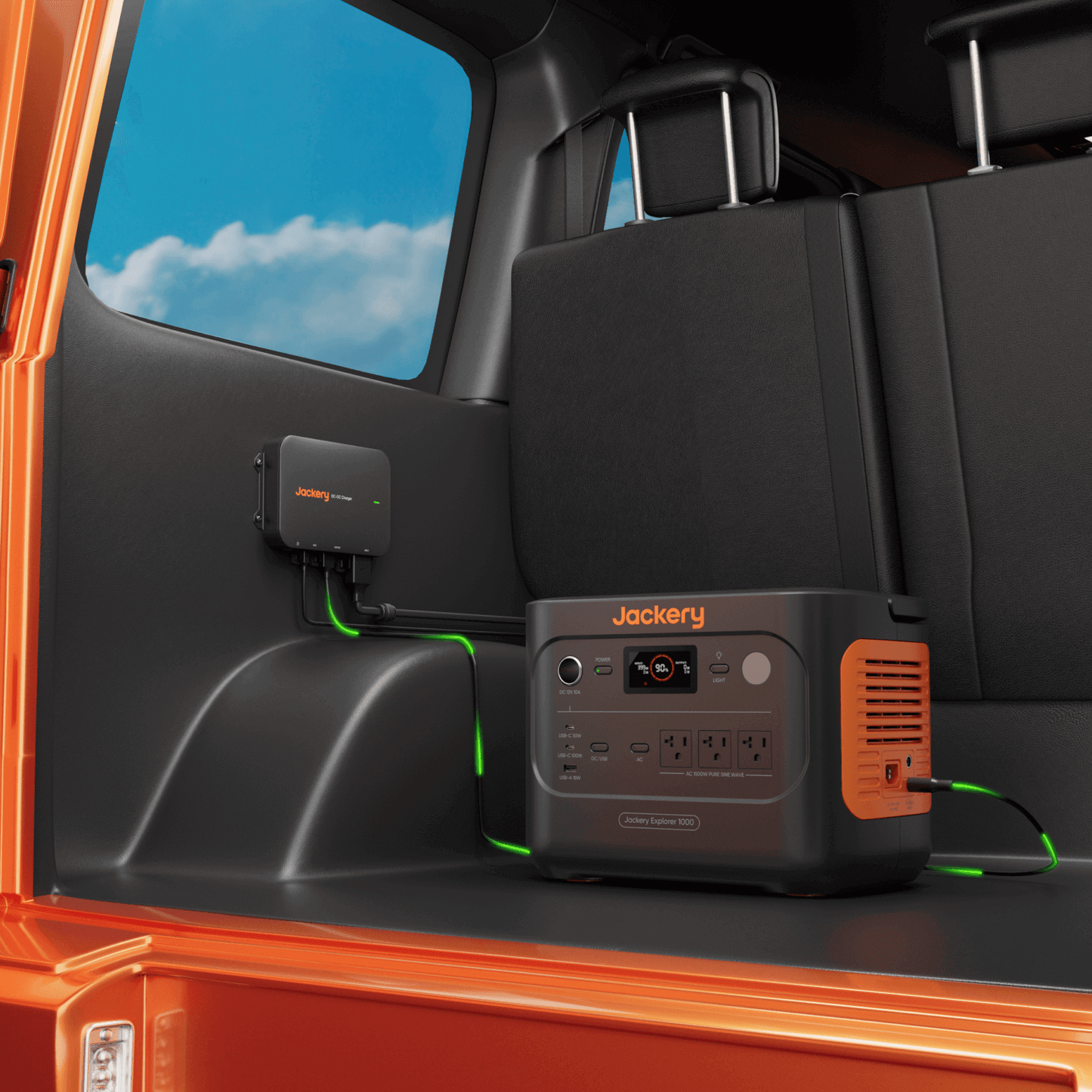
The Jackery DC-DC Alternator Charger is a 600W hardwired charger that refills a Jackery power station off your vehicle's alternator while you drive. It pulls 11.8–32V DC at up to 60A from the starter battery and outputs a regulated 50V DC at up to 12A into the station's DC8020 input. That's about 1 kWh of stored energy for every 2 hours of driving — roughly 6× what a 12V cigarette-lighter socket can move.
Smart auto start/stop watches the ACC signal and battery voltage, so charging only runs while the engine is running and stops the instant you shut off. Your starter battery doesn't get drained at camp. It works on both 12V and 24V systems, so the same unit fits a truck, van, or 24V rig.
The charger measures 10.2 × 6.1 × 1.5 in and weighs 3.5 lbs. IP40 construction handles dust and a -4 to 140°F operating range, but it's a cab/enclosure mount, not an exposed underbody part. This is a hardwired install (fuse at the battery, heavy-gauge run, ACC tap) — capable DIYers manage it, and Jackery recommends a pro shop for clean, safe wiring. Compatible with Jackery stations that have a DC8020 input port.
Couldn't load pickup availability


Overview
A 600W DC-to-DC charger that turns your vehicle's alternator into a fast charging source for a Jackery power station. It outputs a regulated 50V DC at up to 12A through the DC8020 input and runs on 12V or 24V vehicles.
Key features
- 600W max output — about 1 kWh per 2 hours of driving, roughly 6× a 12V socket
- Regulated 50V DC / 12A max output into the Jackery DC8020 input port
- Accepts 11.8–32V DC at up to 60A; works on both 12V and 24V vehicles
- Smart auto start/stop using ACC signal + voltage detection to protect the starter battery
- IP40 dust resistance and a -4 to 140°F operating range
- 3.5 lb unit, 10.2 × 6.1 × 1.5 in; 2-year warranty
Use cases
Built for overlanders, van builds, and 4x4 rigs that move between camps and want the drive to do the charging. On long transit days it refills the station off the alternator instead of leaning on solar, so you arrive with a full bank ready for the fridge, lights, and devices.
- Rated output: 600W max
- Output voltage: 50V DC
- Output current: 12A max
- DC input: 11.8–32V DC, 60A
- Vehicle compatibility: 12V and 24V systems
- Station compatibility: Jackery power stations with a DC8020 input port
- Charge rate: ~1 kWh per 2 hours of driving
- Protection: Smart auto start/stop (ACC signal + voltage detection)
- IP rating: IP40 (dust resistant)
- Operating temperature: -4 to 140°F (-20 to 60°C)
- Working humidity: 5%–95%
- Working altitude: up to 3000 m
- Dimensions: 10.2 × 6.1 × 1.5 in
- Weight: 3.5 lbs (1.6 kg)
- Warranty: 2 years
Which Jackery power stations does it charge?
Any Jackery station with a DC8020 input port — the Explorer Plus and v2 series, such as the 1000 v2, 2000 v2, 2000 Plus, and 3000 Plus. Older stations without the DC8020 port aren't supported, so check for that port before you buy.
How fast does it actually charge?
Up to 600W, which works out to about 1 kWh of stored energy for every 2 hours of driving — roughly 6× what a standard 12V cigarette-lighter socket can deliver.
Will it drain my vehicle's starter battery?
No. Smart auto start/stop uses the ACC signal and battery voltage to charge only while the engine is running and stop the instant you switch off, so it won't pull the starter battery down while you're parked.
Does the ACC wire carry the charging current?
No. The ACC wire is a signal wire only — it tells the charger the engine is on. The 600W of charge current flows through the heavy battery cables, which is why those are the large-gauge runs.
Can I install it myself?
It's a hardwired install: a fuse at the battery, a heavy-gauge run to the charger, and an ACC tap to a key-on circuit. Capable DIYers wire it themselves (many tap ACC from the interior fuse panel), but Jackery recommends a professional shop for safe, tidy wiring.
Is it weatherproof?
It's IP40, so it resists dust but isn't sealed against water. Mount it in the cab or a dry enclosure within the -4 to 140°F operating range — don't expose it on the underbody.