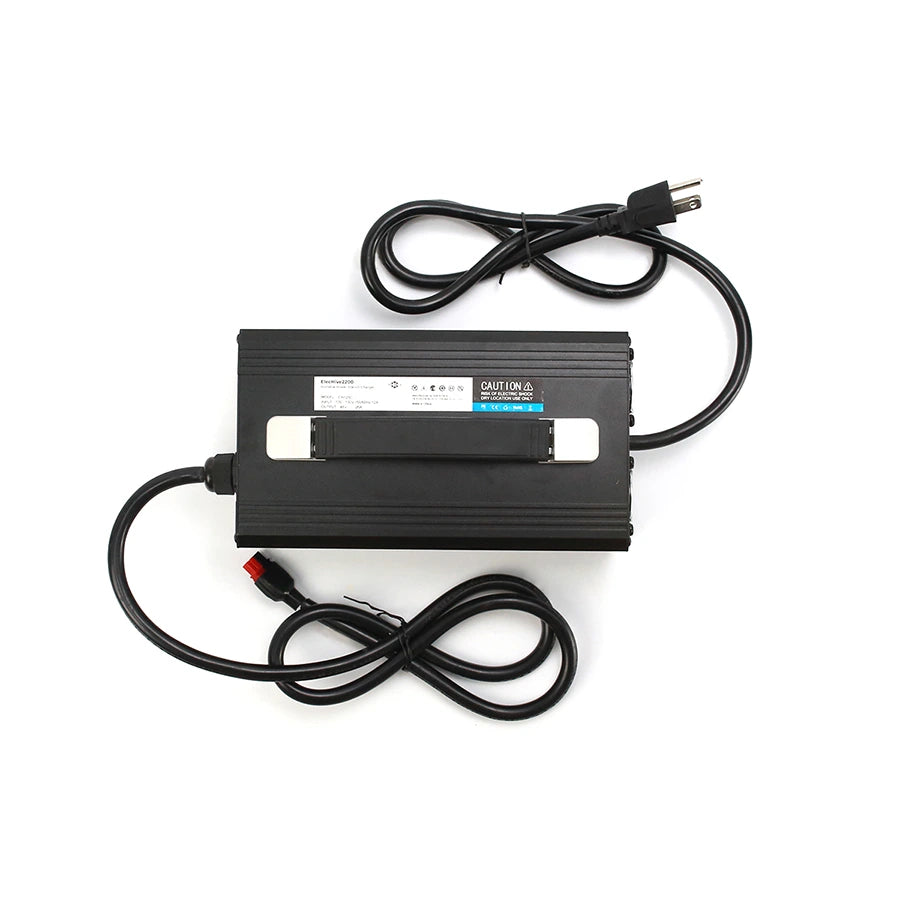
48V Booster for Mark 3
The Zero Breeze 48V Booster is a DC-DC step-up converter that lets you run the Mark 3 portable AC from any 12V, 24V, or 36V power source in your rig — no 48V battery required. The converter block draws from your existing vehicle or house battery system and delivers stable 48V at 600W output through a 1.2-meter hardwired cable that terminates in the Mark 3's D20 connector. Efficiency is 85–90%, which means less waste heat and more run time from your available amp-hours.
The practical case: a 12V 100Ah house battery can power the Mark 3 directly through this booster for a meaningful stint at camp without any new high-voltage hardware. From a 12V source the booster pulls up to 55A, so fusing and wire gauge matter — the 60A fuse on the positive line isn't optional. Step up to 24V or 36V and current draw drops proportionally, which makes a 24V truck system or a 24V–36V lithium bank an easier fit. The included XT90 to Anderson terminal cable handles the input side; an optional XT90 to eye terminal cable (sold separately) connects directly to 12V battery posts if your setup doesn't have an Anderson connector.
Fits the Mark 3 only. Not compatible with the Mark 2 or any other equipment. If you're running a 12V system, confirm your battery can sustain 55A continuous output and route through a 60A+ fuse on the positive line before the booster. The booster is not UL/CE certified for standalone use — it's designed as an integrated component of the Mark 3 power system.
Couldn't load pickup availability

Overview
DC-DC boost converter that steps 12V–36V up to 48V to power the Zero Breeze Mark 3. 600W output, 85–90% efficient, 1.2m hardwired cable with D20 connector. XT90 to Anderson terminal cable included.
Key features
- 600W output at 48V — runs the Mark 3 at full capacity; 85–90% conversion efficiency
- Wide input range: 12V–36V DC — compatible with standard vehicle systems, house batteries, and 24V/36V lithium banks
- 1.2m hardwired output cable — terminates in the Mark 3 D20 connector; no additional adapters on the high-voltage side
- XT90 to Anderson terminal cable included — plugs into Anderson connectors standard on most wired overland rigs; eye terminal cable sold separately for direct battery connection
- Mark 3 only — engineered specifically for the Mark 3 power input; no other Zero Breeze models or third-party devices
Use cases
Running the Zero Breeze Mark 3 from a 12V, 24V, or 36V power source — truck chassis battery, dedicated house battery, or portable lithium bank — without purchasing a dedicated 48V battery system. Overland builds already wired with Anderson connectors can plug in directly with the included cable. 12V users should confirm their source can sustain 55A continuous output.
- Output: 48V DC, 600W
- Input range: 12V–36V DC
- Input current (12V): up to 55A
- Fusing required (12V): 60A+ on positive input line
- Efficiency: 85–90%
- Output cable: 1.2m hardwired, XT90 to D20 (Mark 3 connector)
- Included cable: XT90 to Anderson terminal cable
- Optional cable: XT90 to eye terminal cable (sold separately)
- Weight: 900g
- Compatibility: Zero Breeze Mark 3 only
- Certifications: Not UL/CE certified for standalone use; integrated Mark 3 system component
- Warranty: 1-year limited factory warranty
- SKU: B48
Does this work with the Mark 2?
No. The 48V Booster is engineered specifically for the Zero Breeze Mark 3. The Mark 2 uses a different power system and is not compatible with this converter. Do not attempt to connect the booster to a Mark 2 unit.
What's the minimum battery I need to run this on 12V?
Your 12V source needs to sustain 55A continuous output to run the Mark 3 at full capacity through the booster. A 100Ah lithium battery with a high-discharge BMS is typically sufficient for meaningful run times. Lead-acid batteries can work but may struggle to sustain 55A without voltage sag — a 200Ah AGM bank is a safer starting point. Install a 60A+ fuse on the positive input line regardless of battery type.
What cable is included? Do I need the eye terminal cable?
The kit includes one XT90 to Anderson terminal cable for the input side. If your electrical system already has Anderson connectors (common on wired overland and van builds), you're plug-and-play. If you need to connect directly to battery terminals, the XT90 to eye terminal cable is sold separately by Zero Breeze. Both cables connect to the same XT90 port on the booster — only one is needed at a time.
How does input voltage affect current draw and heat?
At 12V the booster draws up to 55A; at 24V that drops to roughly 27–28A; at 36V roughly 18–19A. Higher input voltage means lower current and less heat generation in cables and connections. If your rig supports 24V or 36V output, running the booster at that voltage is easier on your wiring and connectors. The booster's 85–90% efficiency rating holds across the input range.
Can I mount this permanently in a vehicle?
Yes, with a few considerations. Mount it securely to prevent vibration damage on rough roads. Ensure there's reasonable airflow around the unit — the booster generates heat under load and shouldn't be packed tightly against other components. Route the input cable away from heat sources and secure it against chafe. Use appropriately rated wire gauge for 55A continuous draw if you're hardwiring rather than using the Anderson cable.
What does "not UL/CE certified for standalone use" mean?
The booster is certified as an integrated component of the Mark 3 power system, not as a standalone device for other applications. It's designed to power the Mark 3 and nothing else — don't use it to supply 48V to other loads. This doesn't affect normal use with the Mark 3; it means the certification scope is specific to that system.