


Overlander™ 130 Watt ETFE Semi-Flexible Solar Panel
Overlander™ 130 Watt ETFE Semi-Flexible Solar Panel
Five pounds, seven ounces of SunPower Maxeon Gen III cells that start pulling amps before lesser panels wake up. At 48 by 22 inches, the Overlander 130 lays flat on any standard roof rack and wires into your existing MC4 system with no adapters. The 4mm ETFE shell handles hail, branches, and years of UV without yellowing or delaminating — that's the difference between ETFE and the PVDF coating on cheaper flexible panels. Pair it with the Overland Solar MPPT bundle and you've got a charge system that bolts on in an afternoon.
No se pudo cargar la disponibilidad de retiro


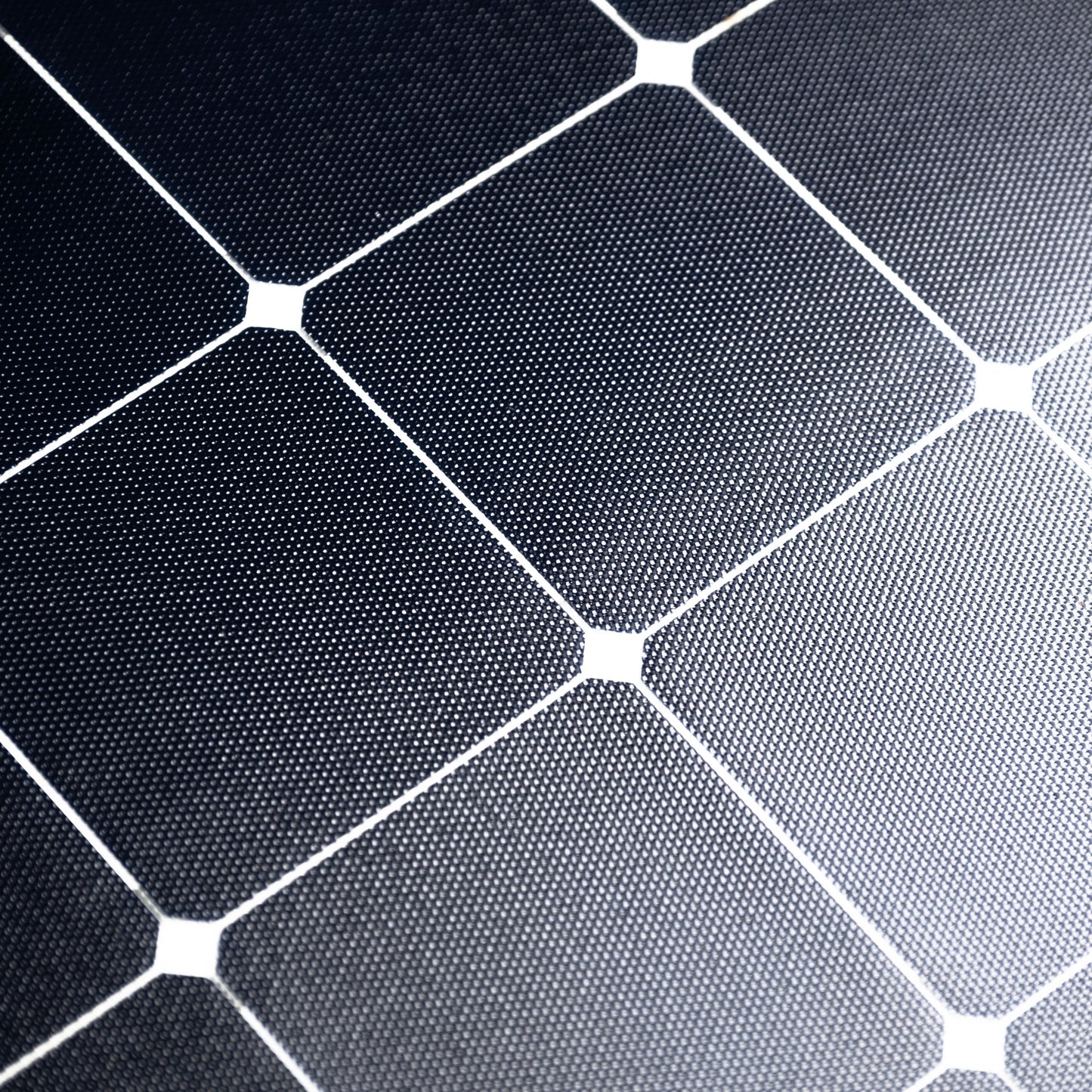
The Overlander 130 is built around SunPower Maxeon Generation III cells — the same cell technology in high-efficiency residential panels. Those cells generate 23.7% efficiency and maintain output at low sun angles and in overcast conditions where standard PERC cells drop off significantly.
The 4mm ETFE (ethylene tetrafluoroethylene) coating is harder and more chemically inert than the PVDF coatings on budget flexible panels. It won't crack from temperature cycling, won't yellow under UV, and won't delaminate from heat buildup on a vehicle roof. The semi-flexible construction handles minor surface curvature — not for compound curves, but solid for flat rack decks, trailer roofs, and hardshell tent shells.
Connections are standard MC4 (labeled positive and negative). Wiring to a charge controller is straightforward: Voc of 26.4V and Isc of 6.37A sit comfortably within the operating range of any 12V MPPT controller. You can run multiple Overlander 130s in parallel to stack amperage — keep total Voc below your controller's input limit. The Overland Solar 10A MPPT bundle wires directly to this panel with no adapters.
Assembled in Boise, Idaho. Overland Solar has been building solar systems since 2007; panels are constructed with primarily North American-sourced materials.
Electrical
- Peak output: 130W
- Open circuit voltage (Voc): 26.4V
- Max power voltage (Vmp): 22V
- Short circuit current (Isc): 6.37A
- Max power current (Imp): 5.9A
- Max system voltage: 600 VDC
Physical
- Dimensions: 48 × 22 in
- Weight: 5 lbs 7 oz (~2,466g)
- ETFE coating: 4mm
- Junction box: Top mounted
- Connectors: MC4 (labeled +/−)
Cell & Build
- Cell type: SunPower Maxeon Generation III
- Cell efficiency: 23.7%
- Surface: ETFE semi-flexible
- Assembled: Boise, Idaho, USA
Warranty & Returns
- Warranty: Up to 5 years (Overland Solar)
- Return window: 14 days
Does this panel need a charge controller?
Yes — the Overlander 130 outputs raw DC solar power and requires a charge controller between the panel and your battery. A 12V MPPT controller rated for ≥26.4V input and ≥6.4A handles this panel at full output. Overland Solar's 10A MPPT bundle plugs directly into this panel with no adapters and includes alligator clamps plus an SAE connection for common camper/trailer solar inlets.
Can I run multiple Overlander 130s together?
Yes. Wire panels in parallel (positive to positive, negative to negative via MC4 combiners) to add amperage without raising voltage. A pair of 130s produces up to 11.8A at 22V into your controller — keep total Voc under your controller's input rating. Series wiring doubles voltage for 24V systems but requires a controller spec'd accordingly.
How does it perform in partial shade or overcast?
Better than most flexible panels. SunPower Maxeon Gen III cells maintain higher low-light efficiency than standard PERC cells. Expedition Portal's independent panel comparison found Overland Solar panels "at the top of the pack" when weight was factored into the performance equation, and noted they generate real power in conditions where cheaper cells stop producing.
What's in the box?
The panel only — no charge controller, mounting hardware, or cable extensions included. The junction box is top-mounted with integrated MC4 leads. Overland Solar sells the 10A MPPT controller bundle and extension cables separately.
How do I mount it?
The panel ships without mounting hardware. Common approaches: VHB tape on flat surfaces, through-bolt to rack crossbars using the panel's grommets (rubber washers recommended to reduce vibration stress), or custom bracket fabrication. The semi-flexible construction adapts to slight surface curvature — avoid sharp bends or compound curves that would stress the cells and laminate.
What's the difference between ETFE and PVDF flexible panels?
ETFE (ethylene tetrafluoroethylene) is harder, more UV-resistant, and more thermally stable than PVDF — the coating used on most budget flexible panels. PVDF panels can yellow, delaminate, or micro-crack from heat cycling over 2–3 seasons. ETFE panels hold up significantly longer under continuous outdoor exposure. It's also why this panel costs more than a Renogy or Newpowa equivalent.